Draw a different ending for one Christmas story
Keep the beginning of a made-up Christmas story and its problem. Draw a second ending on fresh paper, then compare how the two versions get the same gift to its recipient.
Start with a complete invented story
Gather three small sheets and pencils or crayons. This activity uses an original story with talking animals; you can draw it or make up a similarly short one together. Read this whole example first:
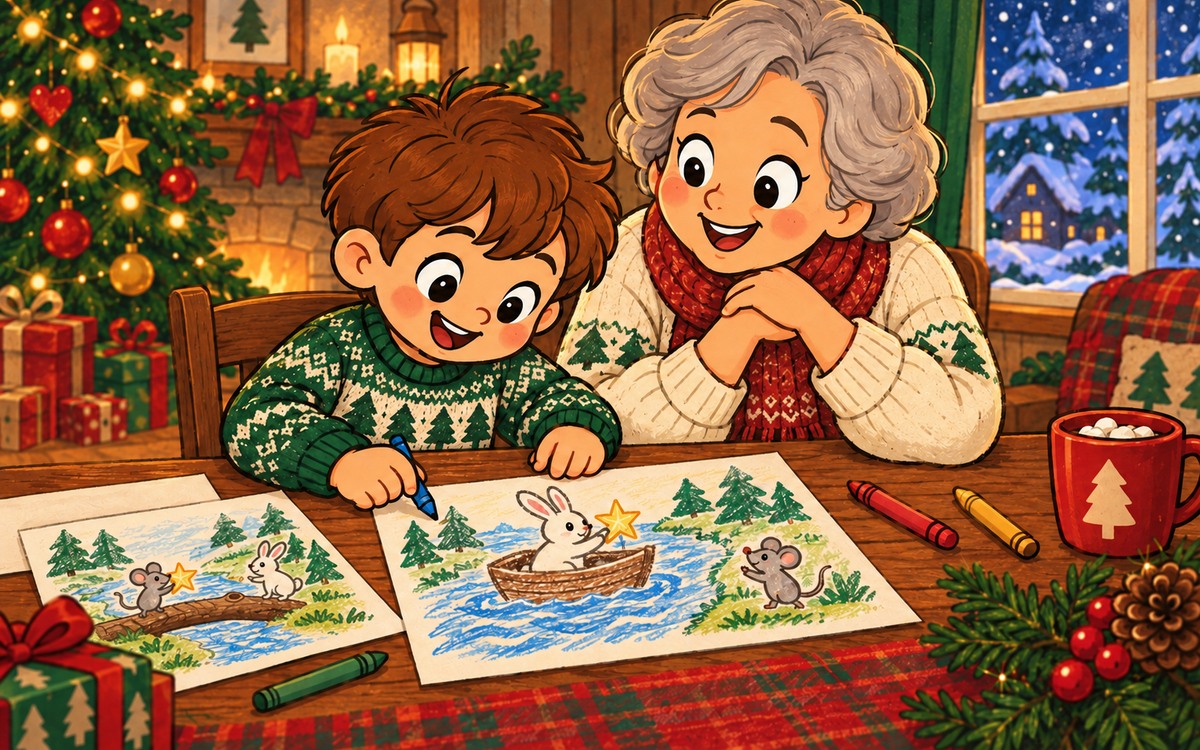
“Mouse made a gold paper star for Rabbit's Christmas tree. On the way, Mouse found that the bridge across the stream was gone. Beaver laid a broad fallen branch from one bank to the other. Mouse walked across and gave Rabbit the star, which Rabbit hung on the tree.”
Now point out the problem: Mouse wants to deliver the star but cannot use the missing bridge. Before changing anything, let your child tell you what happened at the end.
Keep the beginning, save the first ending
On the first sheet, draw Mouse with the star beside the stream and missing bridge. That picture stands for the beginning and obstacle, which stay the same in both versions.
On a second sheet, draw the original ending: Beaver's branch connects the banks and Mouse crosses with the star. A sentence about Rabbit hanging it can finish the account. Put this sheet aside rather than rubbing it out.
Use the third sheet for another ending. Ask one question: “How else could the star reach Rabbit?” Leave time for a picture, a spoken idea or a choice to stop. There is no need to add another character immediately.
Draw the change that makes the difference
One possible new ending is that Rabbit rows over in a little boat and collects the star from Mouse. Draw the boat, Rabbit and the star at the near bank. Mouse can stay there; the gift still reaches its recipient.
Your child can choose a different solution. Ask where the star is after the last action. If the drawing shows only a boat arriving, a final line can complete it: “Rabbit took the star home and hung it on the Christmas tree.”
When your child dictates, write their words and read them back. If they want to change the beginning too, save that idea as a separate story rather than silently altering this comparison.
Look at both endings together
Place each ending beside the same opening picture in turn. Ask what solves the delivery problem in that version: a new crossing, or Rabbit collecting the gift. Both can work within an invented story.
Let your child choose which version to tell, or keep both. One picture and one finishing sentence can be enough for each ending. Store the three sheets together if you want to return to the story; another round is optional.