Christmas in the United Kingdom: crackers, panto and a Welsh visitor
A paper crown, a Christmas pantomime with speaking parts and the Welsh Mari Lwyd: three British Christmas scenes explained for children, without extra preparations or sweeping claims.
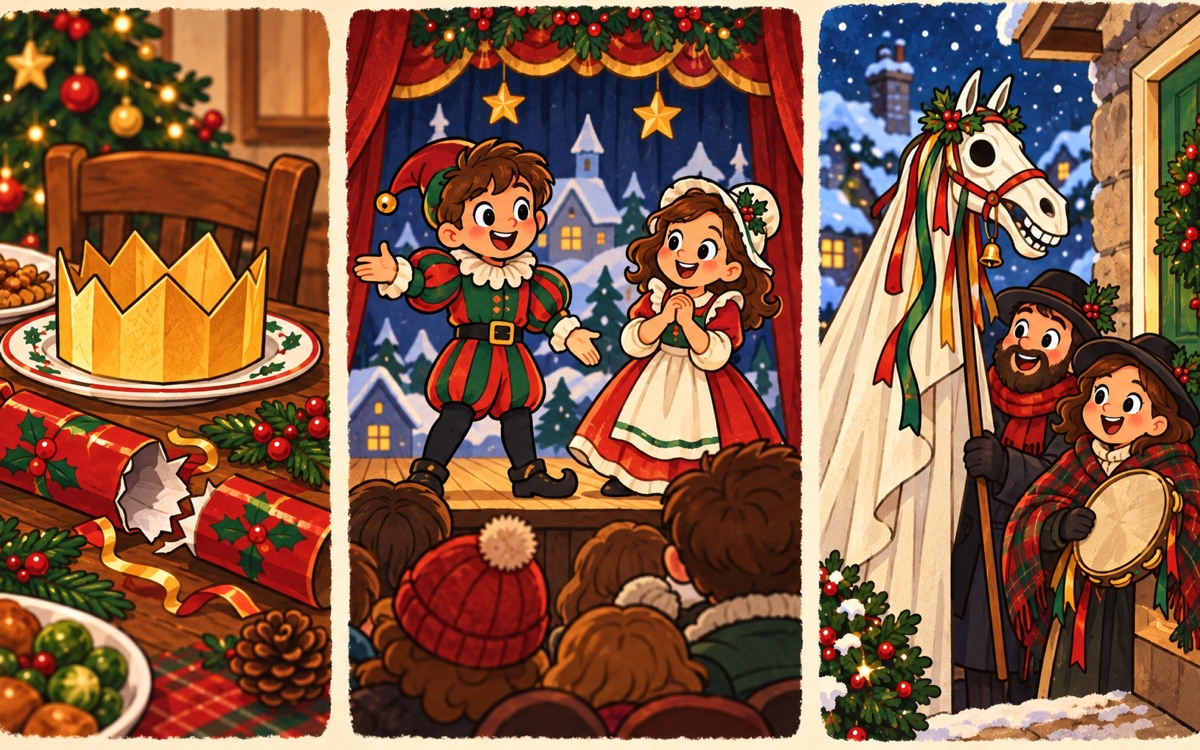
A child spots a paper crown or an unusual horse figure in a picture of Christmas in Britain. “Why do they have that?” A first answer only needs to explain what you are looking at. These three examples will help you distinguish a surprise at the table, a theatre performance and a Welsh singing visit. There is no need to buy anything or plan another Christmas activity.
The United Kingdom has no single Christmas script. These examples are neither a survey of customs across all its countries nor a description of Christmas in every home. They are a small guide to things that might seem puzzling without an explanation.
A cracker: a paper surprise
In this Christmas setting, a cracker is not a food. It is a paper package with ends that people pull. The Victoria and Albert Museum describes its development from wrapped sweets into surprises containing small gifts and paper hats. A hat like this may explain the crown that caught your child’s eye in the photograph.
You can simply say: “That paper package is a Christmas surprise. There might be a hat inside for someone to wear.” The contents are not always the same. This small connection is enough to make sense of the picture; you do not need the same package on your own table.
A pantomime with speaking parts
The word “pantomime” may suggest silent acting or a game in which others guess an action. British Christmas pantomime, or “panto,” means theatre with speaking, singing and audience participation. The V&A overview explains how this theatrical tradition developed and its connection with the Christmas season.
So when an audience responds to the stage in a recording, they are not necessarily disrupting the performance. Joining in is part of it. You can explain to a child: “This show is not silent. The actors speak and sing, and the audience joins in.” The name alone, however, does not tell you which ages a particular show suits.
Mari Lwyd: a visitor from Wales
Mari Lwyd belongs to Welsh traditions. The striking horse figure accompanies visitors who sing and exchange verses with the household. Museum Wales describes the custom and its historical presence, mainly in southern Wales.
Its unusual appearance is only part of the story. The visit, voices and exchange of words at the door matter too. You can explain that it is a figure in a local custom involving singing together. This is a Welsh tradition, and not an English one, and it does not belong to every Welsh household.
Next time you come across a British Christmas picture together, try an ordinary question: “What caught your eye?” The crown, the theatre and the horse figure will each have a story. Your own Christmas can stay just as you like it.