Christmas in Canada: three stops, three different traditions
A shared meal, a disguised visitor and a city parade give you three ways to talk with your child about Christmas in Canada, without turning regional examples into a rule for everyone.
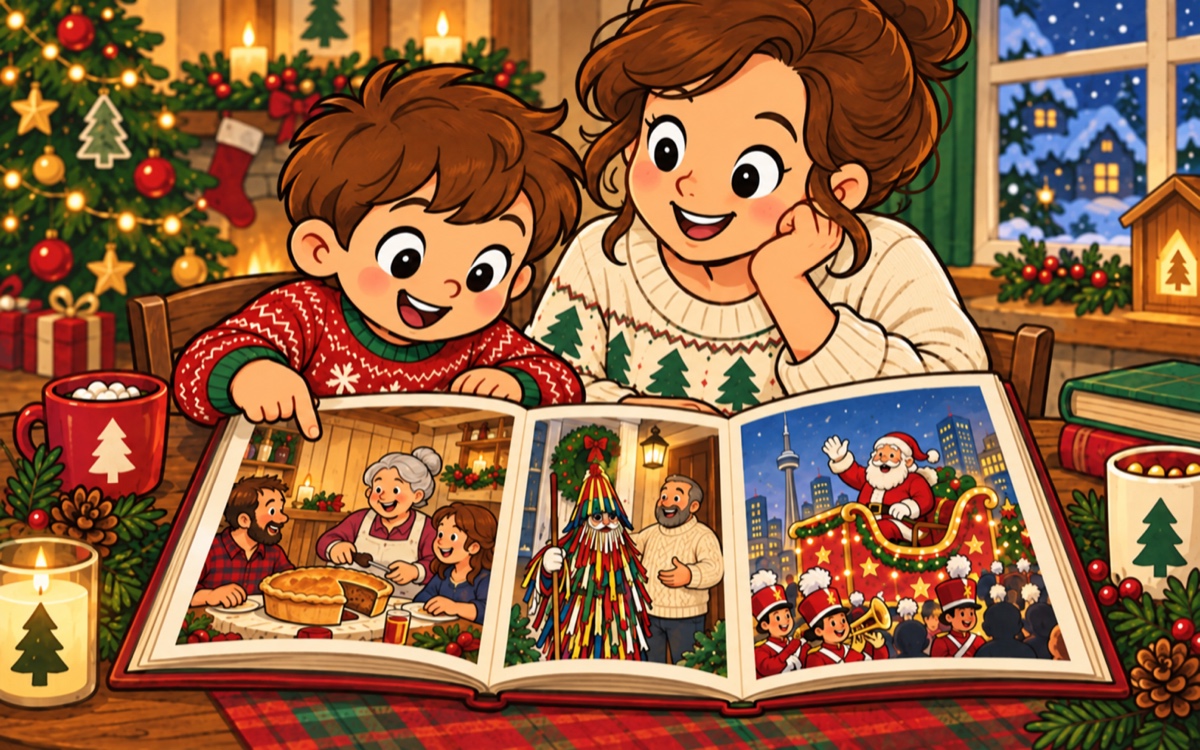
You are looking at a picture from Canada with your child: a Christmas tree, presents and a Santa parade. “So is this how everyone in Canada celebrates Christmas?” Some details may be familiar, but one picture cannot represent a whole country. Let’s visit three places: Québec, Newfoundland and Labrador, and Toronto.
Trees, gifts, music and time together recur in Canadian heritage accounts. These are examples from particular places and periods, however, rather than a survey of what every Canadian family does today. Our three stops explore a shared meal, visits in disguise and a public celebration.
Québec: a shared meal with no single form
Here, Québec means the province, not just the city of the same name. Its Christmas traditions include réveillon, a festive gathering over food. Material from the Office de catéchèse du Québec describes how it has varied over time, between families and across social settings. This does not mean that everyone eats at midnight or attends midnight Mass.
Dishes called tourtière, a term used for meat pies, also vary. Sidney Museum gives a regional example from Lac-Saint-Jean: a deep pie filled with cubed meat and potatoes. It is one form of the dish, rather than a universal Canadian Christmas menu.
Newfoundland and Labrador: who is behind the disguise?
The local tradition called mummering takes us from the table to visiting. According to the community Mummers Festival, visitors arrive in disguise and their hosts guess who they are. Having fun together is part of the custom.
This custom has changed too. Alongside house visits, Mummers Festival describes festival gatherings and creative activities connected with the tradition. Historical material from Newfoundland and Labrador Heritage documents changes in how it has been maintained over time. Mummering is a regional example, rather than a custom of all Canadians. We can introduce it to children through stories; this is not a guide to visiting strangers.
Toronto: Christmas in public spaces
Toronto’s Santa Claus Parade shows another form of celebration: a city parade. Its organizer dates the first parade, supported by Eaton’s department store, to 1905. Alongside family meals and visits in disguise, we have a celebration in public space. This is a historical example, rather than this year’s outing schedule.
Next time you come across a Canadian Christmas picture, you can return to these three stops: a shared meal in Québec, disguised visits in Newfoundland and Labrador, and a public parade in Toronto. These are selected examples, rather than a complete map of the holidays. One simple idea is enough for a child: a familiar tree can belong to different Christmas stories.
Sources
- Institut de la famille / Office de catéchèse du Québec
- Sidney Museum; Sydney Fuhrman
- Mummers Festival
- Newfoundland and Labrador Heritage Website / Memorial University — Philip Hiscock, 1999; archived October 16, 2026. Historical account; current source-host access was unavailable. Archived copy
- Canadian Register of Historic Places, administered by Parks Canada
- The Original Santa Claus Parade