Christmas in Germany: the stories behind a boot, a calendar and a wooden pyramid
A St Nicholas boot, a December calendar and a wooden pyramid serve different purposes. Explore them with your child without treating one custom or regional craft as the whole of Christmas in Germany.
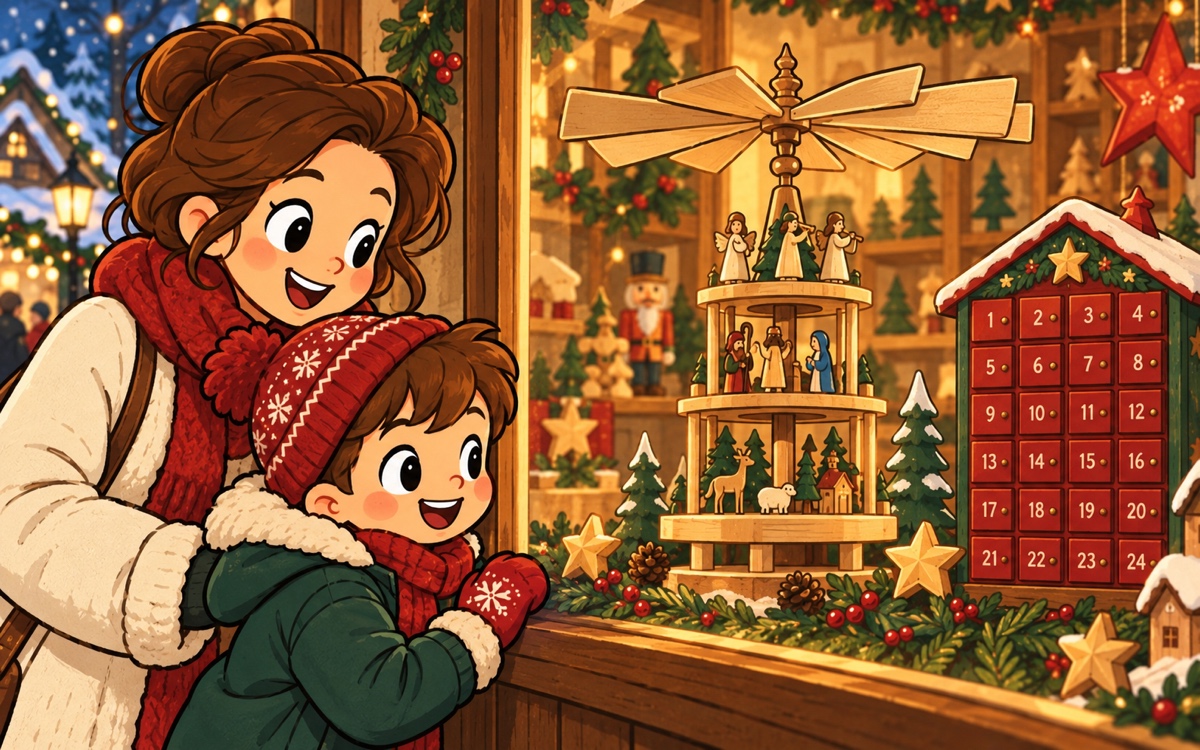
A wooden pyramid turns in a shop window, and your child asks, “What is that?” You do not need to know every German Christmas custom. Start with what you can see. A boot by the door, numbered windows and a turning pyramid each tell a different story: one about St Nicholas, another about waiting, and a third about a craft from a particular region.
The boot belongs to St Nicholas
German St Nicholas customs include putting out a shoe or boot on the evening of December 5 and finding a surprise inside on the morning of December 6. You could explain: “Some children put out a boot for St Nicholas and find a surprise in it the next morning.” The boot belongs to St Nicholas; it does not explain how Christmas gifts are given in Germany.
Parents in a German family discussion describe putting out boots in the evening and discovering their contents in the morning; what goes inside varies by family. These are individual experiences, not a rule for every home. You do not need to buy a special stocking or introduce another round of gifts. If you know other St Nicholas customs, talk about what is familiar and what is different. Otherwise, start with the boot and its morning surprise.
A calendar helps count down
A December calendar numbered 1–24 may hide pictures or little surprises. If you have one at home, look at its numbers together: the calendar counts the days, while the St Nicholas boot belongs to one particular morning.
Calendars have not always looked the same. A historical exhibition at the museum in Chemnitz also featured calendars with pictures to stick on, rotating parts and sliding figures that came before the familiar opening windows. Ask your child: “How could you show the next day without opening a little door?” You need not make or draw anything; an idea is enough.
The wooden pyramid comes from a particular region
Regional handmade decorations also appear at German Christmas markets. Wooden nutcrackers and Christmas pyramids are examples from the German part of the Ore Mountains, called the Erzgebirge. When you look at a pyramid, notice how the figures are arranged and that it can turn. There is no need to explain what makes it move or try to set it going.
You can introduce it simply: “This is an example of a craft from the Ore Mountains. It does not mean every German family has a pyramid like this.” Knowing where it comes from helps explain the decoration. But one regional object cannot represent every household, just as a picture of one decoration cannot show the whole of Christmas.
Three objects, three different stories
Next time you spot a boot, calendar or pyramid, return to this simple distinction: St Nicholas has his own day, the calendar counts down, and a wooden decoration may represent a particular region. Choose only what your child asks about. A shared look and a few sentences are enough for a little Christmas discovery.
Sources
- German National Tourist Board: Advent calendars, markets and St Nicholas boots
- Kunstsammlungen Chemnitz: historical Advent calendar exhibition
- Tourismusverband Erzgebirge: regional Christmas traditions
- Staatliche Museen zu Berlin: historical Christmas pyramid exhibition
- Family discussion: what parents put in St Nicholas boots (individual experiences)