Build a small Christmas scene with blocks you already have
Choose a house, a pretend tree and a clear path between them. A little paper parcel helps you check whether the layout works.
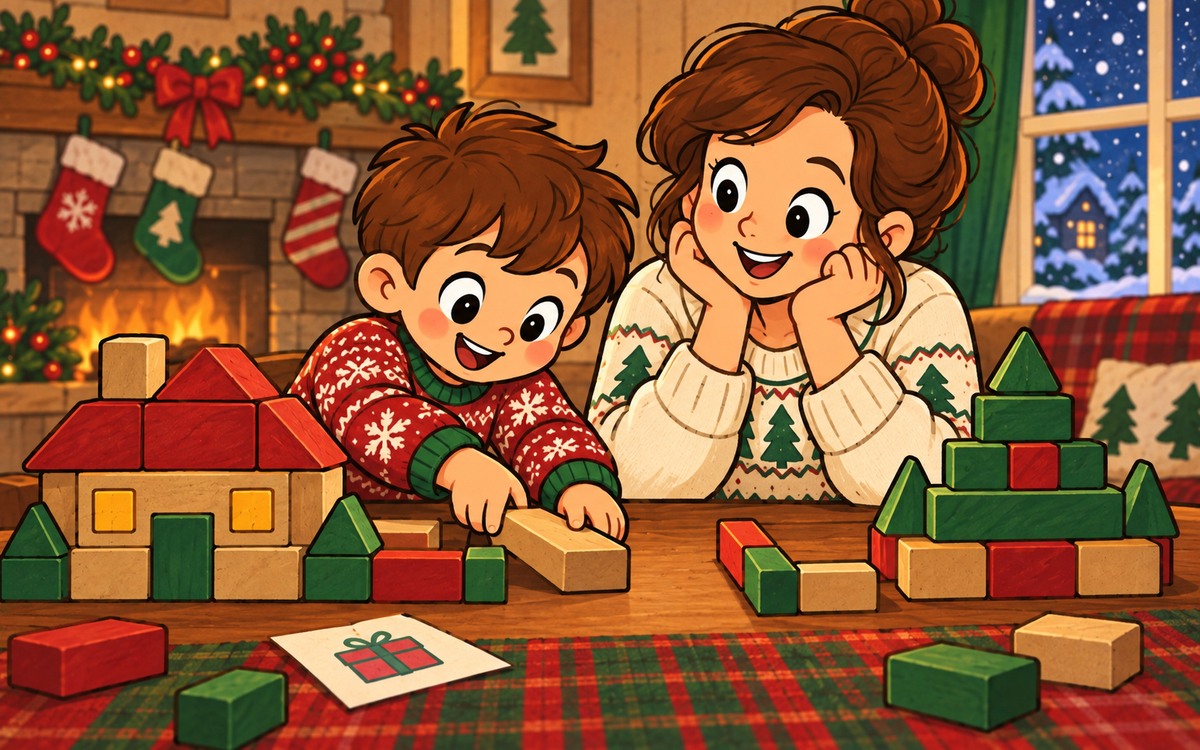
Bring a few of your child's usual building blocks to a clear part of the table. Your Christmas scene needs only three things: somewhere to arrive, something that stands for a tree and a route between them. Choose from the pieces you have rather than designing a village that requires another set.
Give each part a place
Use a low surface where the child can reach the whole scene. Leave space around it for hands and for the route. Choose blocks appropriate for the children joining in and follow their usual toy instructions. Keep the buildings low enough to remain stable when you move a piece nearby.
Agree what will represent each part before building. In this proposed example, a broad block is a house, a short stack is a tree and the gap between them is the route. A tree shape or particular color is optional: your child can simply tell you what a stack means. If two people are building, decide which area each will start with and leave the route open together.
Make one small journey through the scene
Draw a parcel on a small paper card. Place it beside the house and move it along the table towards the pretend tree. Keep the paper flat; you are checking the gap on the table, so you do not need a person or animal figure that can stand by itself.
Where the parcel catches, pause and look at the nearby blocks. Can you move one aside, rotate it or choose a smaller building? Ask the builder before changing their part. The question is concrete: “Where could this block go so the parcel can pass?” Try the adjusted route again rather than deciding from above that the gap looks wide enough.
Decide when the scene is finished
When the parcel reaches the tree, invite your child to describe one thing happening there. They might say that a visitor has arrived or that the pretend house is still waiting. These are made-up events in your toy scene; they say nothing about when your family's real presents will appear.
Leave the scene in place only if the surface can stay free and the toys are stable. Otherwise, walk the parcel back once and put the pieces away. You can draw the layout on a sheet if your child wants to build it again. Another scene can start from the same blocks with a different route; you do not need to preserve every building as a permanent Christmas decoration.
- Our building space:
- What represents the house:
- What represents the tree:
- The route starts and ends at:
- A change that lets the parcel pass:
- Leave it briefly / put it away: