One paper window, two Christmas views
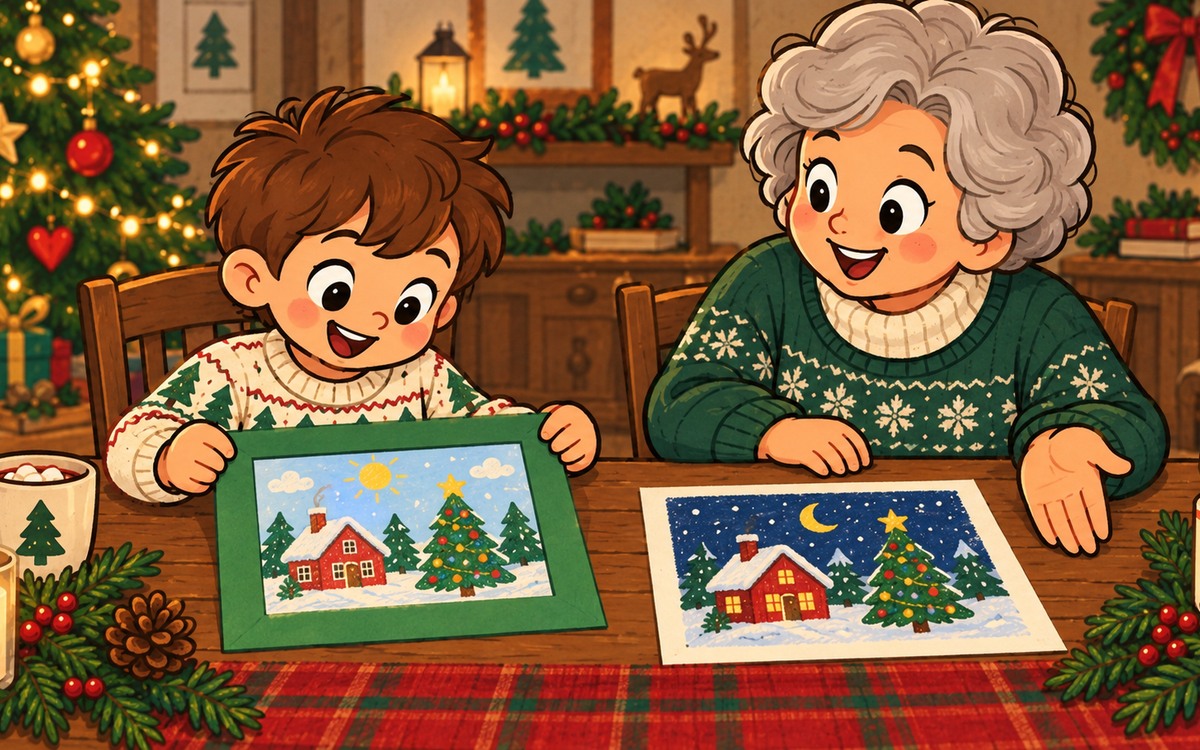
Make a broad paper window frame and place two different drawings behind it in turn. The views can be entirely imagined: a Christmas house by day, then the same house at night.
Make a frame with room to hold
A paper window can show more than one Christmas view. Keep the frame separate from the drawings so your child can change what appears inside. This is a pretend window; the pictures do not have to match the weather outside.
Use thin colored card, pencil, scissors and two drawing sheets as large as the card. Fold the card in half, matching opposite edges. The fold will help you reach the middle without making a cut through the outer frame.
On the folded card, draw half of the window opening as a rectangle with one side along the fold. Keep broad borders at the other edges. When opened, the rectangle will become twice as wide.
Cut only the opening
An adult can help cut the three drawn sides, starting at the fold and returning to it. Remove the cut piece, then unfold the card. You now have one rectangular hole with a broad frame around it. Press the fold gently flatter on the table.
If cutting this opening is awkward, arrange four broad paper strips into a rectangle instead. Glue their overlapping corners and let the frame set before using it.
Place the frame on the first drawing sheet, lining up the outer edges. Trace the inside opening lightly. Repeat on the second sheet. These outlines show where the pictures need to be visible.
Draw two views to swap
Ask your child what their pretend window will show. One idea is a house with a Christmas tree beside it: first in daylight, then at night with a light in the house. Another pair could show the garden before and after a visitor arrives.
Keep the important parts inside the traced rectangles. Check with the frame before adding lots of detail. Your child can draw the same house twice or invent two completely different places.
An adult can help with an outline if requested. One clear difference between the two views is enough; neither sheet needs coloring from edge to edge.
Change the view, then choose an ending
Lay the first picture flat and place the frame over it. Look together at what appears in the opening. Lift the frame, exchange the drawing and put it back. Leave the drawings unglued so they can still change.
Your child may tell you one thing that changed, ask you to choose a view, or simply look. Finish with their chosen picture in the frame. Store both sheets behind it afterwards so the second view stays with the first.
OUR TWO WINDOW VIEWS
Broad frame with one opening: ______
Two sheets match the frame’s outer size.
Opening traced on both sheets: ______
First imagined view: ______
Second imagined view: ______
Important details visible through frame: ______
Lift frame, exchange sheet, replace frame; drawings stay unglued.
Finish view: ______
Store both drawings with the frame.