Let one object change the next step in your Christmas story
Pause a made-up story and offer two object pictures. When your child chooses one, use it in the very next action, then finish what happened. The choice changes the story without needing a whole new cast.
Make two pictures you can both recognize
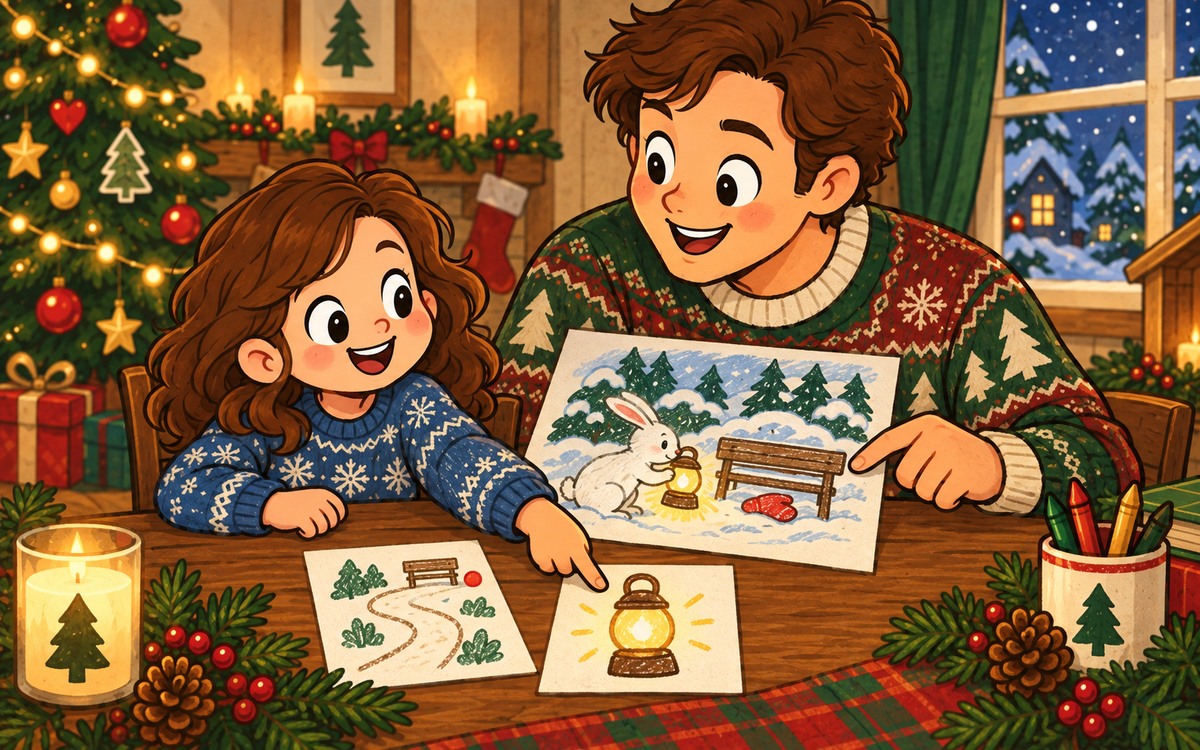
Take two small pieces of paper and crayons. Draw a simple map on one and a little lamp on the other. For the map, a path leading to a bench with a dot beside it is enough. The lamp can have a handle and a bright circle for its light.
Before telling the story, ask what each picture represents. Explain that the map shows a marked place and the lamp lights something nearby. Change an unclear drawing now. These are paper prompts for an invented story, not objects your child has to find around the house.
Stop at a clear choice
Use this original beginning with talking animals: “Rabbit was ready to go to a Christmas picnic, but one red mitten was missing. It was getting dark in the snowy garden. Mouse brought a little map and a lamp.”
Stop there and show the two pictures. Ask, “Which one will Rabbit try first?” Your child can point, name the object or choose not to continue. Wait for the answer instead of selecting a picture while they are still deciding.
Keep the other picture beside it. You are choosing the next action, not guessing which object the storyteller secretly wants.
Use the chosen object immediately
If your child picks the map, continue: “Rabbit followed the path on the map to the marked bench. Rabbit looked underneath and found the red mitten.”
If they pick the lamp, try: “Rabbit carried the lamp through the garden and shone its light into the shadows under the bench. There was the red mitten.”
Both versions reach the mitten, but the action differs. Name the chosen object in the next sentence so the child can hear what their decision changed. With another choice, make its use visible too; a basket might carry the things Rabbit finds.
If your child supplies their own action, use that instead. You can ask what happens after it, without replacing the idea with the sample.
Finish one consequence before choosing again
Close the little story: “Rabbit put on the mitten and went to the Christmas picnic.” An arrival or completed action gives this turn somewhere to stop.
Ask which object helped Rabbit and what it did. Your child can answer with the picture instead of retelling everything. If you want to keep the story, write the child's finishing words and read them back.
For a second turn, return to the same beginning and use the other object, or swap who tells the story. One choice and its consequence are already enough; you do not need to keep adding pictures.
OUR STORY CHOICE
Invented character and starting problem: ______
Picture one means: ______
Picture two means: ______
The place where we pause: ______
Child’s choice: ______
Next action that actually uses the chosen object: ______
What happened after that action: ______
A finishing sentence: ______
Stop here / restart with the other object / swap storytellers.