Rehearse your paper Christmas story before the day
Trace your existing paper route, read one draft message aloud, and rehearse the ending with a blank card. Record a snag, correct it, and check again.
Your paper route is ready and the messages are written. Before you use them with children, follow the plan yourself: trace the route, read one actual message aloud, and practice the ending with a blank card.
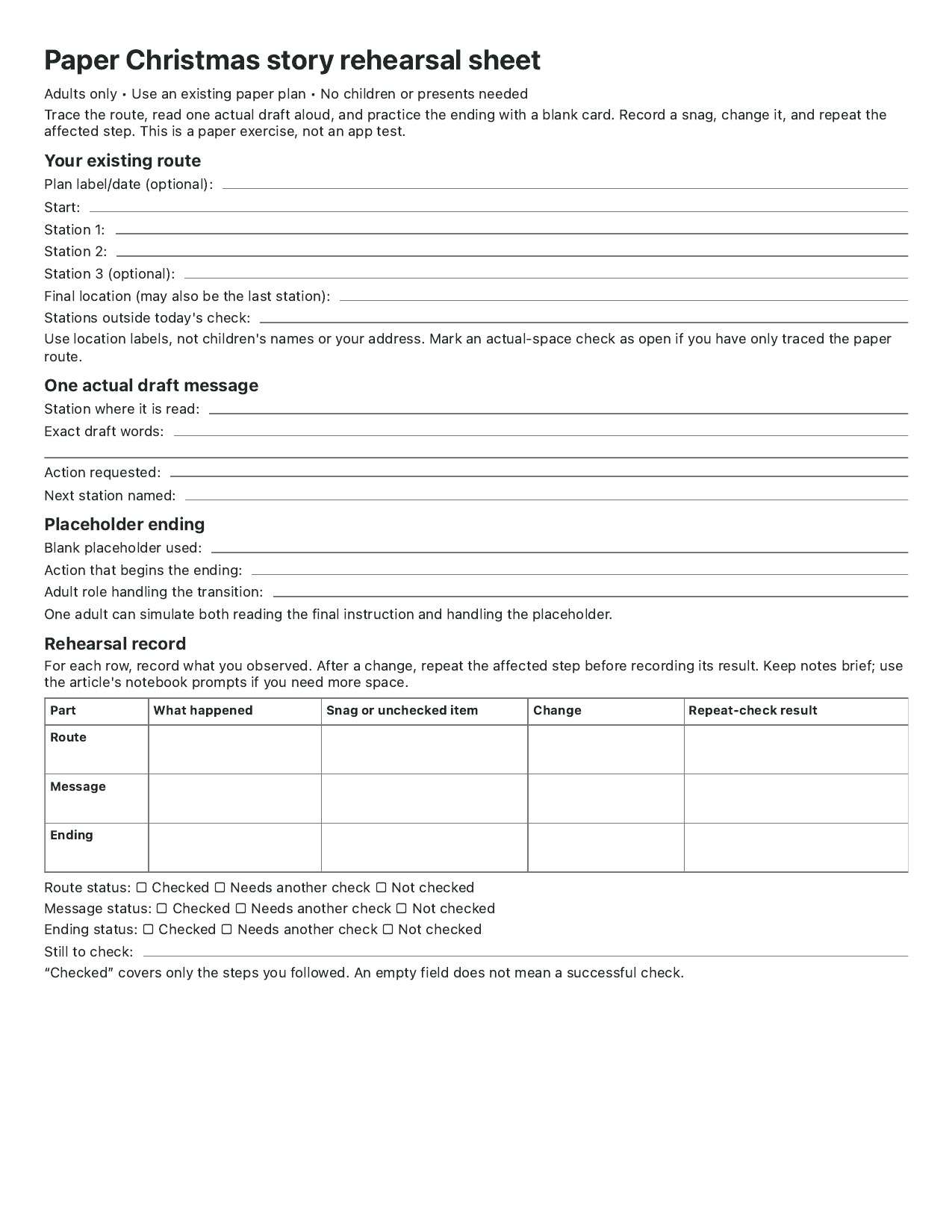
Use the rehearsal sheet to record what happened, fix any snag, and repeat the affected step. You can do the whole exercise alone at a table, without children or presents.
This guide is for a Christmas story you have already prepared on paper. It does not test a Before the Magic app journey or the website's fictional preview.
Put the existing plan on the table
Gather your paper map or station list, one of your draft messages, a pencil, and a plain card to stand for the ending. Keep presents out of the rehearsal.
Give the plan a short label or date if that helps you recognize it later. Leave children's names and your address off the sheet. Use simple indoor location labels such as “kitchen table” or “bookshelf.”
Copy the start, two or three stations, and the final location from your existing plan in order. Note whether the final location is also the last station. If your story has more stations, choose which ones to check today and mark the others “Not checked.”
Choose familiar places that the people taking part can reach. A tabletop check can reveal a label mismatch, but it cannot establish whether the actual space is suitable. If you have not checked the places themselves, record that as an open item.
1. Follow the route as written
Set the station labels on the table in the order shown on your paper map. Move a pencil or your finger from the start to each station and then to the final location. Read each label instead of filling in a missing step from memory.
At every move, ask: “Which place does the paper tell me to go to next?” If the map says “chair” and your station card says “sofa,” write down that mismatch. If two stations share the same label, note where you had to guess.
In the route record, describe what happened. Clarify the label or add the missing instruction, then trace that part again using the corrected paper. Record the repeat-check result separately; writing down a fix does not mean you have tested it.
2. Read one actual message aloud
Choose a draft message that moves the story from one station to the next. Write its station and exact words on the sheet, then read it aloud as written.
Identify the action the message asks for and the place it names. Follow that instruction with your pencil. Does it take you to the next station on the map? If it asks you to find a note, is that note included in the paper plan?
If you need to explain an instruction that the message does not contain, record the missing detail. Edit the draft and read it again. Mark only this message as checked; the result does not cover messages you did not read.
3. Rehearse the ending with a blank card
Put the blank card at the planned final location. Say the last instruction aloud and act out what the adult handling the ending would do next. For example, that adult might place the closing note on the chair after the final paper clue is read.
Write down what begins the ending and which adult role handles it. If you are rehearsing alone, switch between reading the instruction and handling the card yourself. A role label such as “adult at the final station” is enough.
Record any gap between arriving at the last station and beginning the ending. Change the paper instruction or handover note, then repeat the transition with the blank card.
A fictional example: the clue names the wrong place
Imagine a paper story with this route: kitchen table → bookshelf → living-room chair. The kitchen table is the start, the bookshelf is station 1, and the chair is both station 2 and the final location. A blank card on the chair stands for the closing note.
The draft message at the table says: “Go to the sofa and find the next note.” When the adult follows those words, the rehearsal leaves the planned route.
The message record could read:
- **What happened:** The message directed me to the sofa; the next paper station was the bookshelf.
- **Snag or unchecked item:** The destination in the draft did not match the map.
- **Change:** Replace the draft with “Go to the bookshelf and find the next note.”
- **Repeat-check result:** Read the corrected line aloud and followed it to the bookshelf label. This message matched on the repeat check.
At the bookshelf, a final paper instruction directs the adult to the living-room chair. The adult places the blank card there and records the ending check separately. This is an invented example, not a family's experience or a demonstration of product behavior.
Finish with a record of what you checked
Give each part—route, message, and ending—one status: **Checked**, **Needs another check**, or **Not checked**. Use “Checked” only for the steps you actually followed, including any repeat after a change.
Keep open items specific: “Check whether the bookshelf note is reachable” is more useful than “Check everything.” If you change the paper plan later, revisit the steps affected by that change. The sheet records this rehearsal; it does not promise how the celebration will go.
Use the sheet without printing
Copy the following prompts into a notebook. They are the same fields as the printable rehearsal sheet.
**Set up:** Optional plan label/date; start; station 1; station 2; optional station 3; final location; any stations outside today's check.
**Message:** Station where it is read; exact draft words; action requested; next station named.
**Ending:** Blank placeholder used; action that begins the ending; adult role handling the transition.
Make a separate record for **Route**, **Message**, and **Ending**, using these four prompts: **What happened? Snag or unchecked item? Change? Repeat-check result?** Add one status to each record: **Checked / Needs another check / Not checked**.
Finish with: **Still to check**. Leave an untested step open rather than treating an empty field as a successful check.
Where the preparation idea comes from
Scouts' treasure-hunt activity uses a start, finish, and checkpoints, includes route planning, and asks organizers to consider mobility when placing checkpoints. The National Trust's scavenger-hunt guide also includes choosing and checking the space.
Those sources describe outdoor activities. The indoor paper rehearsal, reading a message aloud, and practicing the ending with a blank card are our practical adaptation, not a protocol tested or endorsed by those organizations.
 31
31 36
36 45
45