Help your child write a Christmas thank-you note in their own words
Choose one person, name a gift or shared moment, and help your child add an honest detail. A blank card gives them room to draw, dictate, or write.
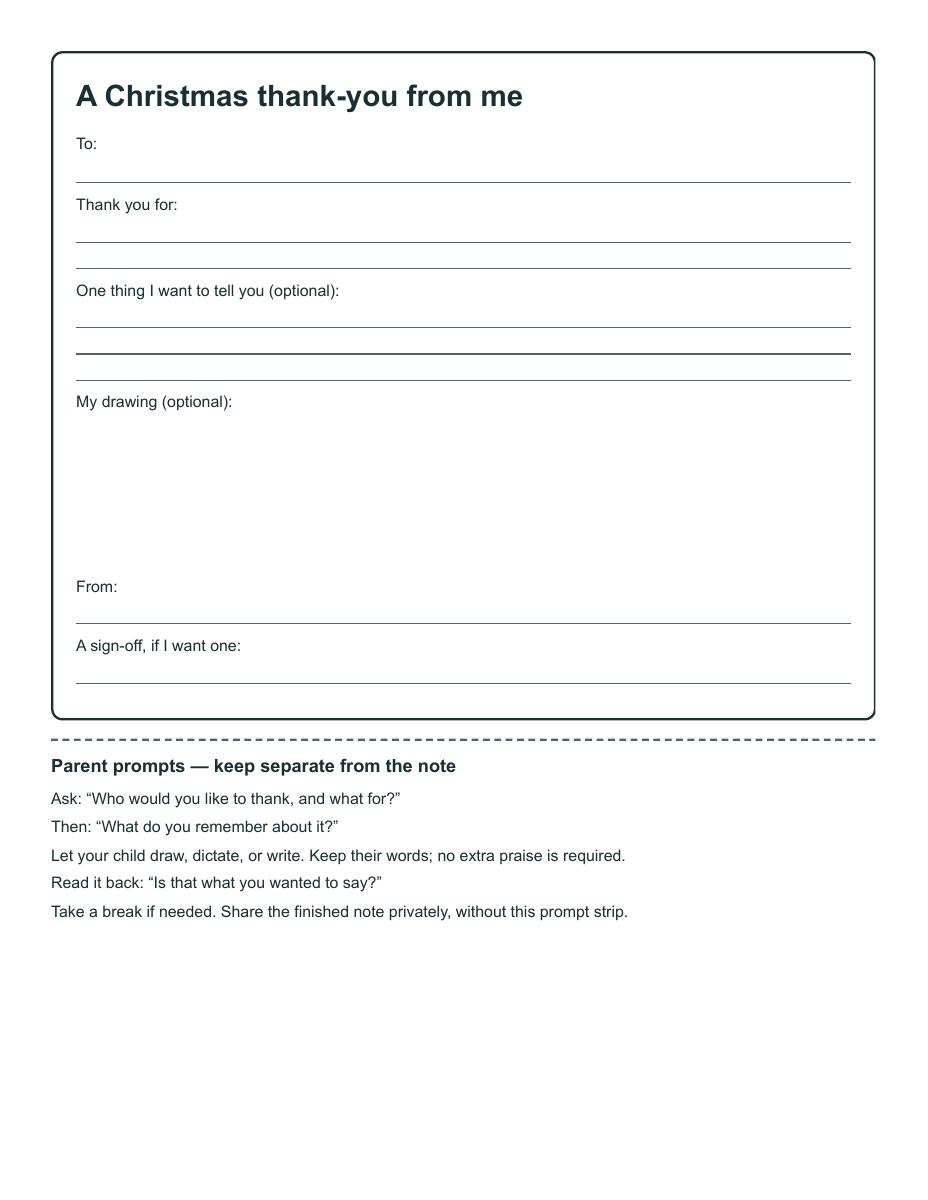
A Christmas thank-you note can be short: name the gift or shared moment, add a real detail if your child has one, and let them choose how to sign off. They can draw, tell you what to write, or write it themselves.
Start with one person and one note. Use the blank card below or paper you already have. No app or special stationery is needed.
Choose what your child wants to thank someone for
Ask: “Who would you like to thank, and what for?” It might be a gift, help with something, or time spent together. Emily Post’s guide to writing thank-you notes suggests naming the particular gift or act and adding a personal detail.
If your child isn’t sure where to begin, offer a concrete choice: “Would you like to thank someone for a present, or for something you did together?” Let them choose the person and the subject.
Choose something that actually happened. There’s no need to write about every present at once.
Find one honest detail
Ask: “What do you remember about it?” Give your child time to answer before offering another prompt.
If they want help, you could ask:
- “Have you tried it yet? What did you do?”
- “Is there something you want to make or do with it?”
- “What part of our time together do you remember?”
Keep the detail they give you, even if it’s small. “I made a red bridge” tells the recipient something specific without adding an adult’s praise.
A polite thank-you doesn’t have to include a claim that your child loves the gift. For a present they haven’t used, a simple “Thank you for the puzzle” can stand on its own. Add a plan only if your child suggests it. There’s no need to promise to play with it or invent a favorite part.
The researcher-authored Greater Good article Five Ways to Raise a Grateful Child distinguishes expressing thanks from feeling gratitude. Listen to what your child has to say rather than treating the card as a test of how they should feel.
Let your child draw, dictate, or write
Choose an approach that feels manageable today. Emily Post’s tips for children and teens include drawing, adult transcription, shared writing, and room for children to express themselves.
Draw: Your child can draw the gift or a moment they remember. Ask whether they want words beside the picture. If they do, write down what they tell you.
Dictate: Let your child say the note aloud while you write. Read it back: “Is that what you wanted to say?” Change it if they ask.
Write: Give them paper and the prompts below. Help with spelling or another practical request while keeping their wording.
Work on one note at a time. If your child needs a break, put it aside and return to it when they are ready. A drawing is optional, and so is an extra sentence.
Use the blank thank-you card
Open the blank thank-you card or download the Letter PDF. You can also copy these prompts onto paper. Leave a prompt blank if the note already says what your child wants to say.
- To: Who is the note for?
- Thank you for: Name the gift, help, or shared moment.
- One thing I want to tell you: Add a real detail in your own words, if you want to.
- My drawing: Optional.
- From: Your name, with a sign-off if you want one.
The parent prompt strip helps you guide the conversation. Keep it separate from the note you give to the recipient.
These three fictional examples show how short a note can be. Use your child’s own words and details from their experience.
Example: a gift already used
Dear Aunt Maya, Thank you for the blocks. I made a red bridge with them. From Sam
Example: time together
Hi Grandpa, Thank you for baking with me. I liked making the star shapes. Love, Alex
Example: a gift not used yet
Dear Uncle Lee, Thank you for the puzzle. From Jo
The last example is complete without an invented plan or extra praise. Your child can add a drawing or another detail if they choose.
Read it back and choose how to send it
Before sending, read the note together. Ask: “Is that what you wanted to say?” Check the recipient’s name too. Let your child choose a sign-off; “From” is enough if they don’t want anything else.
You can give the card in person, mail it, or send the message through your usual private communication method. If you send a photo of the note, keep the recipient’s address and other private information out of the picture. No upload to this website is needed.
If your child already said thank you in person, a follow-up note can be an optional extra. Emily Post’s guidance on different ways to say thank you allows that distinction for holiday gifts; it isn’t a rule that every family must write another message.
If the note has been delayed, you can still send it when it’s ready. Emily Post’s children’s guidance also makes room for late notes. There’s no need for a long explanation: begin with what your child wants to thank the person for.
Once the note says what your child means, it’s ready to share.
A Christmas thank-you from me
To:
Thank you for:
One thing I want to tell you (optional):
My drawing (optional):
From:
A sign-off, if I want one:
Name the gift or shared moment, then leave room for your child’s words or drawing.
 30
30 31
31