Fit six paper shapes into a Christmas box
Trace one card rectangle before cutting it into six broad pieces. Your child then packs those pieces inside the outline, moving and turning them until none overlaps or crosses the boundary.
Make a set that has a known fit
Gather a piece of firm card, a larger sheet of paper, a pencil, a ruler marked in centimeters, crayons and ordinary paper scissors. An adult can make the cuts or help according to the child's experience. Start with a plain rectangle, not a favorite drawing that someone wants to keep.
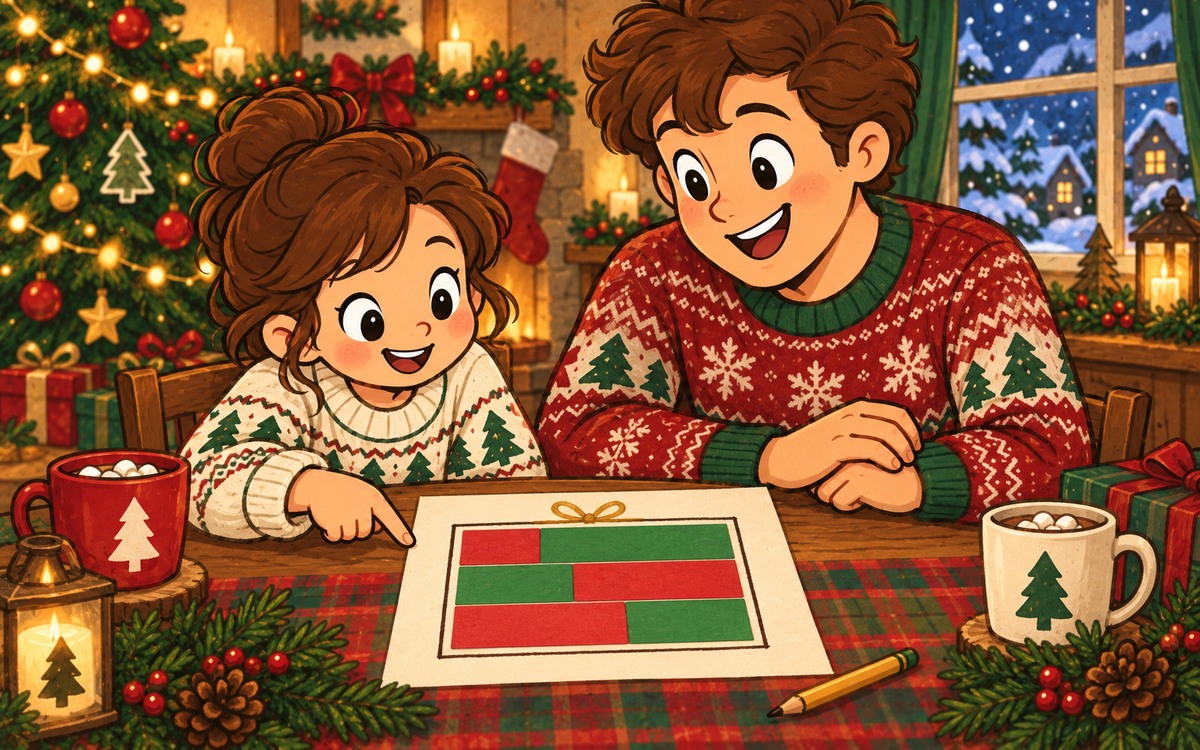
For one manageable example, use an 18-by-12-centimeter rectangle. Put it on the larger sheet and trace all four outside edges. Lift it and leave that outline empty. A little bow drawn above the boundary can make this your pretend Christmas box.
Mark the card into three strips, each 18 centimeters long and four wide. Cut those strips apart, then divide each into two broad rectangles: at six centimeters on the first, eight on the second and ten on the third. That gives six pieces altogether. Use help for measuring if needed.
Check the whole set before mixing
Put all six pieces back in their original arrangement inside the traced outline. Their outside edges should meet the boundary, and neighboring pieces should sit beside each other without overlap. Trim no piece during play: that would change the set.
If the cutting wandered, keep the actual pieces together and check whether their original arrangement still fits. Redraw the outside boundary around that complete arrangement if necessary. A neat printed grid is unnecessary.
The child may color some pieces red and others green. Keep them flat; broad blocks of color are enough. Move the pieces beside the outline, then offer the empty box.
Try a place, then change it
Choose one piece and put it inside the box. Slide or turn it to leave space for another. Each piece must lie flat, within the boundary, with no layer covering another piece. The aim is to fit the whole set, not reproduce a hidden picture.
When the last piece will not fit, take one or two out and try a different arrangement. An adult can describe what is visible: “These two edges overlap.” Let the child make the next move instead of announcing every position.
Leave a starting point when needed
If six loose pieces feel too much, return one complete strip to its original position and leave four pieces to place. You can also rebuild the whole rectangle together, then remove only one piece for the child to replace.
Finish when you have tried enough. Keep the six pieces and boundary sheet in one envelope. Next time, check the count first; a missing piece is a reason to repair the set, not ask someone to solve an incomplete box.
OUR SIX-PIECE BOX
Original card rectangle: 18 × 12 cm.
Trace its outside edge before cutting.
Three strips: 18 × 4 cm each.
Split the strips at 6, 8 and 10 cm respectively.
Six pieces checked in their original arrangement: ______
The box boundary matches the actual complete set: ______
During play: flat, inside, no overlaps, no trimming.
Help today: one strip placed / only one piece to replace / play together.
All six pieces and the boundary sheet stored together: ______